Full report
Paint protection film installers can encounter a panel that the cutting database cannot find. It might be a newly released vehicle, a different trim level, an aftermarket bumper or an add-on part the original vehicle manufacturer never supplied.
PPF Engine, a desktop application developed in Estonia, wants shops to be able to make those missing patterns themselves. The product is accepting preorders ahead of an estimated December 2026 delivery, rather than being available for immediate download.
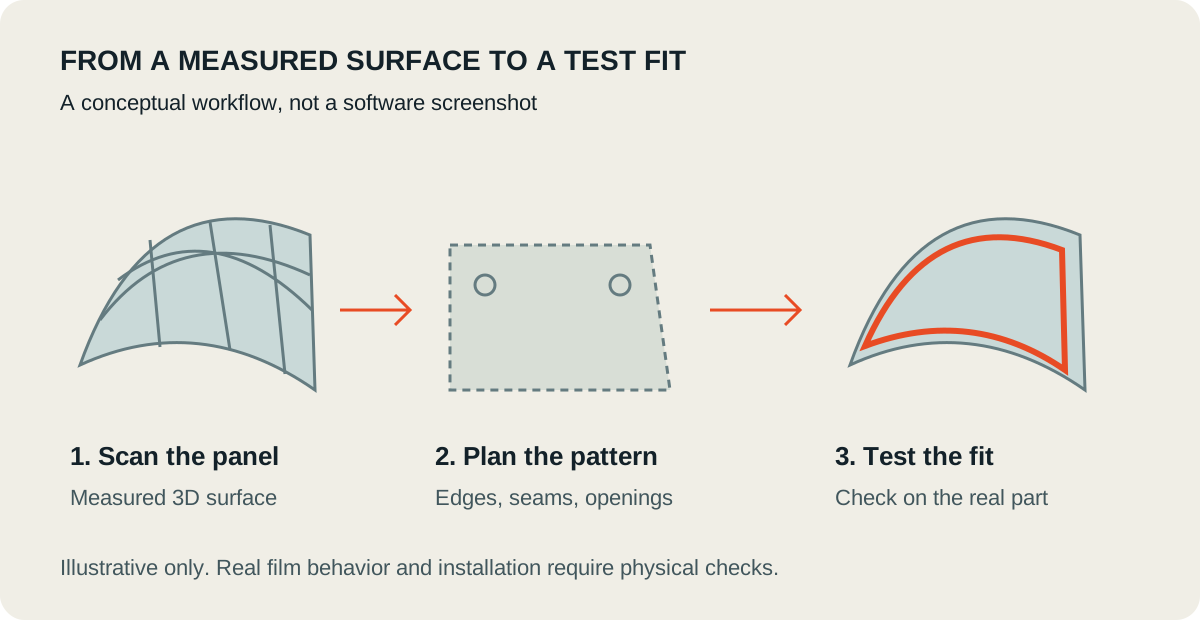
The concept is straightforward: scan the real part in three dimensions, choose the film's coverage, flatten the curved shape into a cutting pattern, and export a file for a compatible plotter. The developer says the process also lets installers examine stretch, adjust seams and edge wraps, and create openings for features such as bolts and badges.
That is a different proposition from the cutting systems most shops know, which focus on choosing and editing existing patterns from a large vehicle library.
The announcement is a presale, not a completed public launch
PPF Engine's website lists a $400 prepaid first year for a one-seat license and says that price is also locked for annual renewals on the original founder license. It lists a planned public price of $900 per year. A buyer pays during the presale, but the 12-month license begins only when software access is delivered. The first term does not renew automatically, and the developer offers full refunds before access begins. Prices are in US dollars; applicable transaction taxes are calculated at checkout.
The product's preorder terms identify its seller and developer as Andify OÜ, based in Tartu, Estonia. The site says the software is already running in a working PPF studio, but it has not yet been released for general installer download. The precise public announcement date could not be established from the reviewed material.
Why the STEK Estonia job matters
The most concrete demonstration is not a typical sedan hood. It is a RAM 1500 fitted with aftermarket fender flares in a STEK Estonia workshop.
According to PPF Engine's published case study, STEK Estonia supplied a 3D scan of one flare because the existing pattern libraries did not cover the add-on part. The PPF Engine team used it to prepare a one-piece template measuring approximately 1,485 by 435 millimeters, with nine openings for recessed bolts and five small relief notches to help the shape fit its curves.
The case study includes workshop images of the cut film being applied. It says the exported pattern was delivered in common file formats, SVG, DXF and PLT, and that the finished pattern could be kept for future jobs involving that same flare. The claimed pattern-processing step took about three minutes; the site does not establish that the entire scanning, preparation, cutting and installation process took three minutes.
This example answers an obvious installer question: what happens when a car is familiar but the exact part is not? A library may contain the factory RAM panels and still have nothing usable for a customer's aftermarket flare. A measured custom pattern could let a shop cover the additional part without waiting for a supplier to add it to a catalog.
The source also requires a careful distinction. STEK Estonia is the business featured in the case study. PPF Engine's seller is Andify OÜ. Andify's published portfolio lists both STEK Estonia projects and PPF Engine development. Those relationships do not establish PPF Engine as a global STEK software launch. STEK EDGE is a separate STEK cutting-pattern platform.
A useful idea, but not a one-button operation
Creating a usable cut file is more complicated than taking a picture of a panel. A vehicle surface curves in multiple directions, while the film begins as a flat sheet. An installer needs to decide where the material can stretch, where a seam is acceptable, and which edges should stop flush or turn around the panel.
PPF Engine says its workflow brings those decisions into the editor. It accepts STL, OBJ and PLY scan files and produces SVG, DXF or PLT/HP-GL exports. The company also shows work on a BMW X3 30e charging cap, including different options for wrapping or stopping the film at its edges and leaving space around a raised badge.
A shop still needs a suitable 3D scanner, computer and compatible cutting setup. The developer reports end-to-end tests with Shining 3D EINSTAR Rockit and EinScan Rigil scanners with a Graphtec FC9000 plotter. Other equipment may accept the file formats, but format compatibility is not proof that a particular device has been successfully tested with this workflow.
The company also recommends physically test-fitting a pattern before committing production film. No independent broad field trial, measured reduction in installation hours, or comparative waste study was identified in the materials reviewed for this report.
What installers should watch next
PPF Engine's appeal will be clearest to shops that regularly work on custom builds, rare vehicles, aftermarket parts and model variants missing from their libraries. A conventional database remains useful for routine vehicles already covered by established templates.
Three practical questions will determine whether the new approach catches on after delivery. Can outside installers make accurate scans on difficult paint and complex bumpers? Will the exported files work smoothly with the cutters already in their shops? And will the total time needed to scan, adjust and test a custom template be reasonable compared with the methods those shops already use?
For now, PPF Engine has opened an interesting new route for the work a pattern catalog doesn't cover. Its reported STEK Estonia installation gives readers a specific example to examine, while the expected December release will be the next meaningful milestone.
At a glance
Product: PPF Engine, custom 3D-scan-to-PPF-pattern software
Developer/seller: Andify OÜ, Tartu, Estonia
Status: Preorder; installer delivery estimated December 2026
Pricing shown: $400 presale first year; $400 locked annual renewal for original one-seat license; planned public price $900/year
Files: STL/OBJ/PLY input; SVG/DXF/PLT output
Published real-world example: STEK Estonia RAM 1500 aftermarket fender flare
Evidence limit: Company demonstrations and case studies; no independent hands-on review
Dates, context & legal notes
Sources & reporting notes
- PPF Engine product, capabilities and presale PPF Engine
- Preorder terms Andify OÜ · Source dated September 19, 2026
- STEK Estonia RAM 1500 installation case study PPF Engine
- Scanner and plotter compatibility PPF Engine
- BMW X3 30e charging-cap case study PPF Engine
- Developer portfolio Andify OÜ
- Separate STEK EDGE platform STEK
This article is an original, AI-assisted summary of the sources above. It does not claim firsthand reporting or independent product testing. Our editorial standards · Corrections policy